The BMCT assesses aptitude for mechanical understanding, often utilizing questions accessible via PDF resources. Gmail, and Google accounts, facilitate access to study materials and practice tests.
What is the BMCT?
The Bennett Mechanical Comprehension Test (BMCT) is a diagnostic tool evaluating an individual’s understanding of mechanical principles. It’s frequently used by employers and educational institutions to gauge a candidate’s aptitude for roles requiring mechanical reasoning. Accessing practice materials, often found as Bennett mechanical aptitude test questions and answers in PDF format, is crucial for preparation.
Gmail and associated Google accounts streamline access to these resources. The BMCT isn’t a test of learned knowledge, but rather an assessment of inherent mechanical intuition. It tests how well someone can apply basic physics principles to real-world scenarios, and preparation through readily available PDFs can significantly improve performance.
Why is the BMCT Used?
The BMCT serves as a predictor of success in roles demanding mechanical aptitude, like engineering, technical trades, and military positions. Employers utilize it to efficiently screen candidates, identifying those with a natural grasp of mechanical concepts. Preparation is key, and resources like Bennett mechanical aptitude test questions and answers in PDF format are invaluable.
Gmail and Google accounts simplify access to these study aids. The test helps determine if an applicant can quickly understand and solve problems related to levers, gears, and fluid dynamics. Utilizing available practice materials, often downloadable as PDFs, boosts confidence and improves scores, ultimately aiding in career advancement.

Understanding the BMCT Question Types
BMCT questions assess mechanical principles through diagrams and scenarios; Bennett mechanical aptitude test questions and answers PDF resources help familiarize test-takers with these formats.
Spatial Reasoning Questions
Spatial reasoning within the BMCT evaluates your ability to mentally manipulate two- and three-dimensional objects. These questions often involve visualizing how shapes fit together, or how an object will appear when rotated or viewed from a different angle. Bennett mechanical aptitude test questions and answers PDF materials frequently include examples of these types of problems, allowing for focused practice.
Successfully tackling these questions requires strong visualization skills and the capacity to mentally deconstruct and reconstruct shapes. Utilizing practice PDFs can significantly improve your performance by exposing you to common question formats and building your spatial awareness. Gmail and related Google resources can aid in locating these valuable study tools.
Mechanical Advantage Questions
Mechanical advantage questions on the BMCT test your understanding of how simple machines – like levers, pulleys, and gears – amplify force. These problems often require calculating the force needed to move an object, or determining the efficiency of a mechanical system. Bennett mechanical aptitude test questions and answers PDF resources are invaluable for mastering these concepts.
Practice PDFs provide worked examples demonstrating how to apply relevant formulas and principles. Accessing these materials through platforms like Gmail and Google can streamline your preparation. Understanding concepts like force, distance, and work is crucial for success, and consistent practice with sample questions is highly recommended.
Fluid Mechanics Questions
Fluid mechanics questions on the BMCT evaluate your grasp of principles governing liquids and gases, including pressure, buoyancy, and flow rates. These questions frequently involve scenarios with pipes, containers, and hydraulic systems. Finding reliable Bennett mechanical aptitude test questions and answers PDF materials is key to preparation.
PDF resources often present diagrams requiring analysis of fluid behavior under different conditions. Utilizing Gmail and Google accounts allows easy access to these study aids. Mastering concepts like Pascal’s Law and Archimedes’ Principle is vital, and practicing with sample problems builds confidence and problem-solving skills.
Electrical Circuits Questions
Electrical circuits questions on the BMCT test your understanding of basic electrical concepts like voltage, current, resistance, and power. Expect scenarios involving series and parallel circuits, Ohm’s Law applications, and simple circuit analysis. Accessing Bennett mechanical aptitude test questions and answers PDF documents is crucial for focused practice.
Many PDF resources provide diagrams of circuits requiring you to determine current flow or voltage drops. Gmail and Google accounts streamline access to these materials. Familiarity with circuit components (resistors, capacitors, etc.) and their functions is essential. Consistent practice using sample questions builds proficiency and test-taking speed.
Velocity and Acceleration Questions
Velocity and acceleration questions within the BMCT assess your grasp of kinematic principles. These often involve scenarios depicting moving objects – cars, trains, or falling items – requiring you to calculate speed, distance, or time. Finding Bennett mechanical aptitude test questions and answers PDF materials is vital for targeted preparation.
Expect questions testing understanding of uniform versus non-uniform motion, and the relationship between velocity, acceleration, and displacement. Utilizing Gmail and Google accounts simplifies access to practice resources. Mastering these concepts, alongside consistent practice with sample problems from PDF sources, significantly improves your performance.
Force and Motion Questions
Force and motion questions on the BMCT frequently explore Newton’s Laws of Motion. These scenarios often involve calculating forces, analyzing resultant forces, and predicting the motion of objects under various forces. Accessing Bennett mechanical aptitude test questions and answers PDF resources is crucial for effective study.
Expect problems involving friction, gravity, and applied forces. Gmail and Google accounts streamline access to online practice tests and study guides. Successfully tackling these questions requires a solid understanding of vector addition and the concepts of inertia, mass, and acceleration. Consistent practice with PDF examples will build confidence.

Key Concepts Tested in the BMCT
Core mechanical principles—gears, levers, electricity, and fluid dynamics—are central. Bennett mechanical aptitude test questions and answers PDF materials aid comprehension of these concepts.
Gears and Pulleys
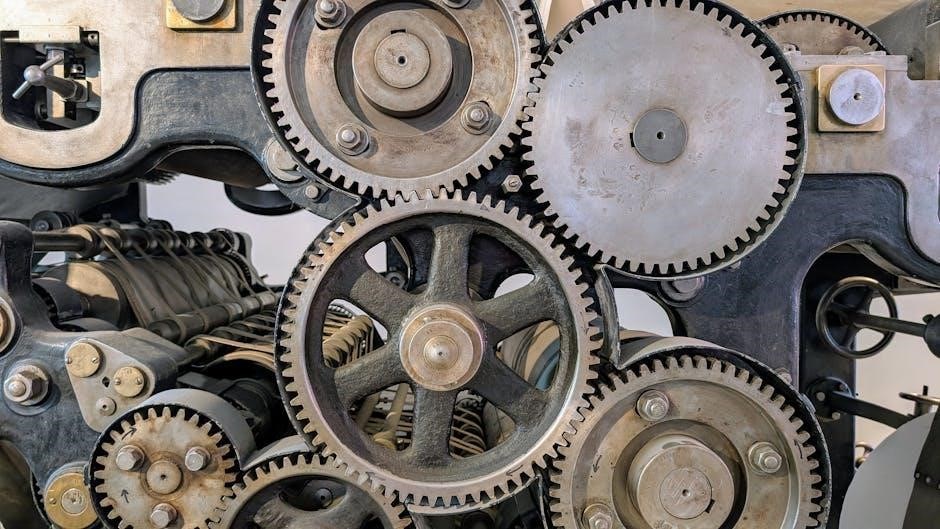
Gears and pulleys are fundamental mechanical components frequently assessed on the BMCT. Understanding gear ratios – the relationship between the number of teeth on gears – is crucial for determining speed and torque changes. Similarly, pulley systems involve analyzing mechanical advantage based on the number of supporting ropes.
Bennett mechanical aptitude test questions and answers PDF resources often dedicate significant sections to these topics, providing diagrams and calculations. Mastery requires visualizing how these systems transmit force and motion. Gmail and associated Google accounts can streamline access to these vital study materials, enhancing preparation for the test’s practical application questions.
Levers and Inclined Planes
Levers and inclined planes represent simple machines central to BMCT assessment. Questions often focus on calculating mechanical advantage – the force amplification achieved by these devices. Understanding fulcrum placement in levers (first, second, and third class) is key, as is relating the angle and length of inclined planes to force required.
Bennett mechanical aptitude test questions and answers PDF materials frequently include practice problems involving these concepts. Accessing these resources is simplified through platforms like Gmail and Google accounts. Effective preparation involves visualizing force vectors and applying basic physics principles to determine optimal solutions, ensuring a strong grasp of these foundational mechanics.
Basic Electricity
The BMCT frequently tests understanding of fundamental electrical concepts. This includes Ohm’s Law (Voltage = Current x Resistance), series and parallel circuits, and power calculations. Questions may involve determining current flow, voltage drops, or resistance values within simple circuits. Recognizing the function of components like resistors, batteries, and switches is crucial.
Bennett mechanical aptitude test questions and answers PDF resources often dedicate sections to electrical principles. Utilizing Gmail and Google accounts streamlines access to these study materials. Mastering these basics, alongside practice problems, builds confidence and improves problem-solving speed, vital for success on the test.
Simple Machines
The BMCT heavily features questions on simple machines – levers, pulleys, inclined planes, wedges, screws, and wheel-and-axle systems. Understanding mechanical advantage, force, and work is paramount. Questions often require calculating the force needed to lift an object or determining the efficiency of a system.
Bennett mechanical aptitude test questions and answers PDF materials provide detailed explanations and practice problems for each machine type. Accessing these resources via Gmail and Google accounts simplifies preparation. Familiarity with these concepts, coupled with consistent practice, significantly boosts your ability to quickly and accurately solve related BMCT problems.
Fluid Dynamics Principles
The BMCT tests understanding of fluid pressure, buoyancy, and flow rates. Questions frequently involve calculating pressure at a given depth, determining the force exerted by fluids, or analyzing fluid flow through pipes and containers. Concepts like Pascal’s Law and Archimedes’ Principle are crucial.

Bennett mechanical aptitude test questions and answers PDF resources offer detailed explanations and worked examples of these principles. Utilizing Gmail and Google accounts streamlines access to these study materials. Mastering these concepts, alongside consistent practice from available PDFs, will enhance your problem-solving skills and improve your BMCT performance.

Strategies for Answering BMCT Questions
Utilize practice PDFs and Gmail access for efficient study. Focus on diagram analysis, process of elimination, and time management for optimal results.
Reading Comprehension and Diagram Analysis
Mastering the BMCT hinges on carefully dissecting each question’s wording and thoroughly analyzing accompanying diagrams. Many questions present scenarios visually, demanding precise interpretation of mechanical systems. Accessing practice materials, often found as PDFs online and shared via platforms like Gmail, is crucial.
Pay close attention to labels, arrows indicating direction, and the relationships between components. Don’t skim; understand what is being asked before attempting a solution. Effective diagram analysis involves identifying key elements, visualizing movement, and translating the visual information into a logical understanding of the mechanical principles at play. Practice with numerous examples will sharpen these skills.
Process of Elimination Techniques
When facing challenging BMCT questions, employing the process of elimination is a powerful strategy. Often, you can confidently discard obviously incorrect answer choices, narrowing down the possibilities. Utilizing practice tests, frequently available as downloadable PDFs and accessible through Gmail, helps refine this skill.
Look for answers that contradict fundamental mechanical principles or don’t logically align with the diagram presented. Even if unsure of the correct answer, eliminating improbable options significantly increases your chances of selecting the right one. Remember, the BMCT tests understanding, not necessarily complex calculations; logical reasoning is key.
Time Management During the Test
Effective time management is crucial for success on the BMCT. The test is timed, and rushing can lead to careless errors. Prioritize questions, tackling easier ones first to build confidence and secure points. If a question proves particularly challenging, make a note and return to it later, rather than getting stuck.
Regular practice with BMCT questions, often found in PDF format and accessible via platforms like Gmail, will help you gauge your pacing. Knowing how long each question should take allows for better allocation of time during the actual test. Avoid spending excessive time on any single problem.
Understanding Units of Measurement
The BMCT frequently tests your ability to work with different units of measurement. Pay close attention to whether values are expressed in metric or imperial units – inconsistencies can lead to incorrect answers. Be comfortable converting between units like feet and meters, pounds and kilograms, or inches and centimeters.
Practice questions, readily available as PDF resources and often accessed through platforms like Gmail, will reinforce unit conversion skills. Ignoring units is a common mistake; always include them in your calculations and ensure your final answer has the correct unit specified.

Resources for BMCT Preparation
Numerous PDF resources offer practice questions and answers, often accessible through Gmail and Google accounts, aiding preparation for the Bennett Mechanical Comprehension Test.
Official BMCT Practice Materials
Locating official BMCT practice materials can be challenging, as direct access isn’t always readily available. However, exploring assessment provider websites and professional development platforms is a good starting point. While a dedicated, freely available PDF of official questions is rare, some organizations offering the BMCT as part of recruitment processes may provide limited sample questions.
Candidates should also investigate if the institution administering the test offers practice materials for purchase. Utilizing these resources, even if fee-based, ensures alignment with the actual test format and difficulty. Remember that Gmail and Google accounts can be used to access and organize any purchased materials or links to relevant resources. Thorough preparation is key to success.
Online BMCT Practice Tests
Numerous websites offer online BMCT practice tests, often providing instant scoring and feedback. Many platforms allow timed simulations, mirroring the actual test environment. Searching for “Bennett Mechanical Comprehension Test practice” yields various options, some free and others subscription-based. Be cautious when downloading PDF resources from unfamiliar sources, prioritizing reputable test preparation websites.
Gmail can be used to register for these services and receive updates. While these tests aren’t official BMCT materials, they help familiarize candidates with question types and improve speed. Remember to critically evaluate the quality of the practice tests and focus on understanding the underlying mechanical principles, not just memorizing answers.
BMCT Study Guides and Workbooks
Dedicated BMCT study guides and workbooks are valuable resources, often containing detailed explanations of mechanical concepts and numerous practice questions. These materials frequently include answer keys and step-by-step solutions, aiding in self-assessment. Many guides are available in PDF format for convenient access and portability.
Utilizing Gmail for purchase and delivery is common. Look for guides specifically tailored to the BMCT, as general mechanical aptitude books may not cover the precise topics tested. Supplementing workbooks with online practice tests provides a comprehensive preparation strategy. Remember to actively engage with the material, working through problems and seeking clarification when needed.
Sample BMCT Questions and Answers (PDF Focus)
Numerous PDF resources offer sample BMCT questions and detailed answers, crucial for familiarization with the test format and difficulty level. These PDFs often categorize questions by topic – gears, levers, fluid mechanics, and electrical circuits – allowing targeted practice. Gmail can be used to locate and download these valuable materials.
When reviewing answers, prioritize understanding the reasoning behind the solution, not just memorizing the correct choice. Look for PDFs that provide explanations, not just answers. Combining sample questions with full-length practice tests, accessible online or via PDF, maximizes preparation effectiveness.
Where to Find Reliable BMCT PDF Resources
Locating trustworthy BMCT PDF resources requires careful searching. While many websites claim to offer practice materials, verifying their accuracy is essential. Utilize search terms like “Bennett Mechanical Comprehension Test practice PDF” within Gmail or a preferred search engine. Look for PDFs originating from reputable test preparation companies or educational institutions.
Beware of outdated or poorly formatted PDFs. Prioritize resources with clear diagrams, detailed explanations, and a substantial number of practice questions. Online forums and career counseling websites sometimes share links to reliable BMCT PDFs, offering a community-vetted approach.

Analyzing Sample BMCT Questions
PDF resources offer example questions, aiding comprehension of concepts like gear ratios and lever arms, mirroring Gmail’s accessibility to learning materials and practice tests;
Example Question 1: Gear Ratio Calculation
Consider two gears meshed together: Gear A has 20 teeth, and Gear B has 60 teeth. If Gear A makes 12 revolutions, how many revolutions will Gear B make?
Many BMCT PDF practice materials present similar problems. The key is understanding the inverse relationship – more teeth mean fewer revolutions.
To solve, calculate the gear ratio (60/20 = 3). Gear B turns 1/3 as fast as Gear A. Therefore, Gear B makes 12 revolutions / 3 = 4 revolutions.
Like accessing Gmail, finding these solutions requires practice and familiarity with fundamental mechanical principles, often found within downloadable PDF guides.
Example Question 2: Lever Arm and Force
Imagine a lever: A force of 100N is applied 2 meters from the fulcrum. What force is needed on the opposite side, 0.5 meters from the fulcrum, to balance the lever?
BMCT PDF resources frequently feature lever problems. The principle is force x distance = force x distance.
Therefore, 100N * 2m = Force * 0.5m. Solving for Force, we get Force = 400N. Understanding this balance is crucial.
Just as Gmail simplifies communication, mastering lever principles simplifies these test questions. Practice with PDF examples builds confidence and speed.
Example Question 3: Fluid Pressure
Consider a hydraulic system: A piston with an area of 0.1 m2 is subjected to a pressure of 500 Pascals. What force is exerted on the piston?
BMCT preparation PDFs often include fluid pressure calculations. Remember, pressure equals force divided by area (P = F/A).
Therefore, Force = Pressure * Area. So, Force = 500 Pa * 0.1 m2 = 50N.
Like accessing Gmail on various devices, fluid pressure principles apply consistently. Utilizing practice PDFs and understanding units are key to success;
Common Mistakes to Avoid
Avoid rushing and misinterpreting diagrams when reviewing BMCT practice PDFs. Secure Gmail logins demonstrate attention to detail – apply this focus to each question!
Rushing Through Questions
A prevalent error is attempting to complete the BMCT quickly, sacrificing accuracy for speed. Many practice PDFs emphasize careful analysis, a skill mirrored in secure online account access like Gmail. Rushing leads to overlooking crucial details within diagrams and calculations.

Take your time to thoroughly understand each scenario presented. Don’t skim the question or the provided visuals. Remember, the BMCT assesses comprehension, not simply speed. Utilizing available resources, like detailed answer explanations in PDF study guides, can reinforce this deliberate approach. Prioritize understanding over finishing quickly, as a correct answer is far more valuable than a fast, incorrect one.
Misinterpreting Diagrams
A common pitfall on the BMCT is misreading or misunderstanding the diagrams presented. These visuals are integral to solving problems, often depicting mechanical systems or electrical circuits. Accessing practice materials, frequently found as PDFs, is crucial for honing diagram analysis skills.
Pay close attention to details like direction of force, gear teeth, or electrical current flow. Ensure you correctly identify all components and their relationships. Similar to securely logging into Gmail, precision is key. Don’t assume anything; base your answers solely on the information provided within the diagram itself. Careful observation prevents errors and boosts accuracy.
Ignoring Units
A frequent error on the BMCT involves neglecting the units of measurement. Whether dealing with force (Newtons), pressure (Pascals), or velocity (meters per second), units are critical for correct calculations and comparisons. Many practice questions, available in PDF format, emphasize unit conversions and their impact on the final answer;
Treat units as algebraic quantities; ensure they cancel out correctly during calculations. Just as Gmail offers secure login, accuracy in units ensures a valid solution. Ignoring units can lead to drastically incorrect results, even if the numerical calculation is correct. Always double-check and include appropriate units in your final answer.
Overthinking Simple Problems
The BMCT often presents deceptively straightforward questions. Candidates frequently fall into the trap of overanalyzing, applying complex formulas where basic principles suffice. Many PDF practice resources highlight this tendency, demonstrating how simpler approaches yield quicker, accurate results. Like accessing Gmail through a secure login, a direct approach is often best;
Focus on understanding the core mechanical concepts illustrated in the diagrams. Avoid introducing unnecessary variables or calculations. If a problem appears simple, it likely is simple. Trust your initial assessment and avoid second-guessing. Practicing with sample questions in PDF format builds confidence in recognizing these scenarios.

Scoring and Interpretation
BMCT scores indicate mechanical aptitude. PDF resources often lack scoring keys, emphasizing practice for improvement, similar to securing your Gmail account for reliable access.
BMCT Scoring System
The BMCT typically employs a standardized scoring method, though specifics can vary depending on the administering organization. Generally, each correct answer contributes to a raw score, which is then converted to a standardized score, often a percentile rank. This allows for comparison against a norm group.
Unfortunately, readily available PDF resources containing detailed scoring breakdowns are often limited. Accessing official practice materials, or those provided by the test administrator, is crucial for understanding the scoring rubric. Like securing a Gmail account, understanding the system is key. Scores aren’t simply about right answers; they reflect aptitude relative to others.
Interpreting Your BMCT Score
Understanding your BMCT score requires context. A higher percentile rank indicates stronger mechanical aptitude compared to the norm group. However, a “good” score depends on the specific requirements of the role or program you’re applying for. Many PDF resources offer general score interpretations, but these should be viewed cautiously.
Like managing a Gmail inbox, prioritizing information is vital. Consider the score in relation to the job description. Some positions demand exceptional mechanical reasoning, while others require only a moderate level. Accessing official score reports, if available, provides the most accurate assessment.
What is a Good BMCT Score?
Defining a “good” BMCT score is nuanced. There isn’t a universal benchmark; it’s relative to the specific employer or educational institution. Scores are often percentile-based, indicating your performance compared to others. Many PDF practice materials provide score ranges, but these are guidelines only.
Similar to efficiently managing a Gmail inbox, understanding expectations is key. A score in the 70th percentile or higher is generally considered strong. However, highly competitive roles may require scores exceeding the 85th percentile. Research the typical score range for your target position to gauge your competitiveness.